What is a Manual Linear Stage and How Does it Work?
A Manual Linear Stage is a device designed for precise movement along a straight line. It plays a crucial role in various applications, such as microscopy or CNC machining. With its simplicity and effectiveness, users can expect consistent results.
By manually adjusting the stage, operators achieve accuracy in positioning. This control often leads to greater satisfaction in tasks requiring precision. However, it demands a steady hand and clear focus. Even minor errors can affect outcomes significantly.
The design of a Manual Linear Stage is often straightforward. It usually features a platform that moves along a track. There's room for improvement, as the mechanism could face wear over time. A balance between ease of use and durability is essential for optimal performance.
What is a Manual Linear Stage? Definition and Overview
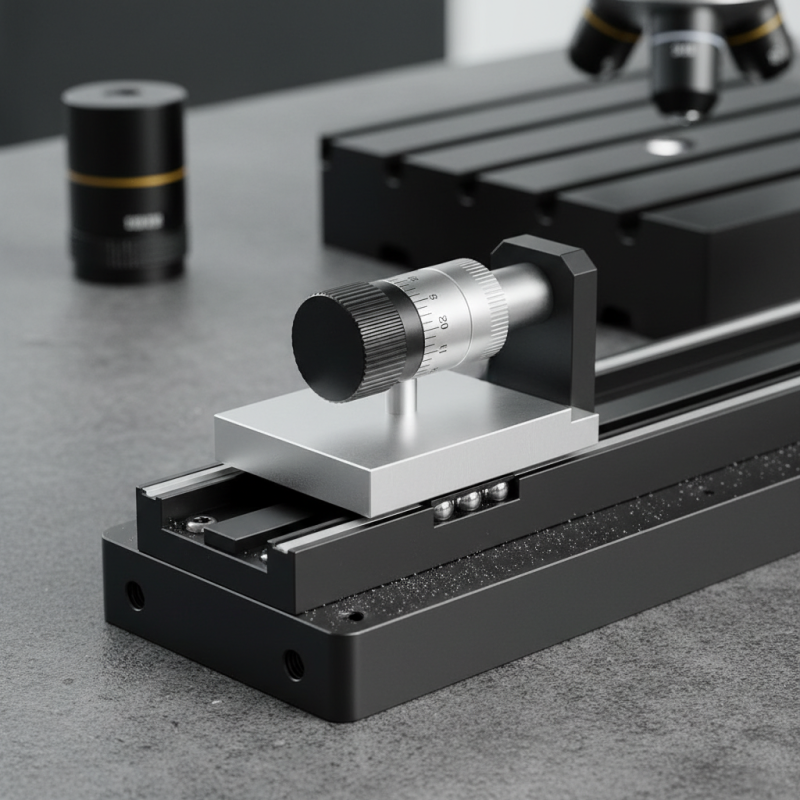
A manual linear stage is a precision device used for linear movement in various applications. It allows smooth and controlled adjustments along a straight line. This is essential in fields like microscopy, automation, and optical engineering. The design usually includes a base, a platform, and a guiding mechanism that ensures stability.
The operation of a manual linear stage is straightforward. Users can move the platform by turning a knob or handle. This action makes it possible to slide the platform back and forth. It provides a tactile feel, giving users a sense of control. In some cases, fine-tuning may be necessary. Adjustments can sometimes feel imprecise or require patience.
These stages find applications in experiments and setups needing precise alignment. However, the simplicity can lead to limitations. Users may encounter issues like sticking or uneven motion. Regular maintenance is essential to keep performance up to standard. Overall, understanding this equipment can enhance its effectiveness in practical scenarios.
Key Components of Manual Linear Stages: A Detailed Breakdown
Manual linear stages play a crucial role in precise movement control. They consist of several key components: a base, rail guides, a carriage, and a drive mechanism. The base serves as the foundation, supporting other parts. Rail guides ensure smooth movement along a defined path. The carriage holds the load and moves along the rail. Depending on the design, it can be either fixed or adjustable.
The drive mechanism often features a lead screw or a belt system. A lead screw translates rotational motion into linear movement, offering high accuracy. Meanwhile, belt systems allow for faster travel speeds but may sacrifice some precision. Reports indicate that the global manual linear stage market is expected to reach $1.9 billion by 2026, reflecting its growing importance in manufacturing and research sectors.
Despite their advantages, manual linear stages are not without challenges. Calibration is essential for optimal performance. Misalignment can lead to reduced accuracy and efficiency. Regular maintenance is crucial but often neglected. Data shows that 30% of users experience issues due to improper care. This highlights the need for more attention to detail in their operation and upkeep.
How Manual Linear Stages Operate: Mechanisms and Motion Types
Manual linear stages are essential in many precision applications. They help move components linearly, typically equipped with a lead screw or rack-and-pinion mechanism. The operation relies on manual adjustments, which allow for fine control over the positioning of the stage. This is particularly useful in laboratory settings where micro-level movements are crucial.
Understanding the mechanisms behind these stages can enhance their effectiveness. The lead screw converts rotational motion into linear movement. The rack-and-pinion system, however, utilizes gears to achieve the same goal. Both methods enable smooth motion, but they require careful handling. Operators must be aware that excessive force can damage the components.
Tips: Always control the speed of movement. Rapid adjustments may lead to misalignment or damage. Keep the stage clean and free from obstructions. Regular maintenance can prevent unexpected failures. A thoughtful approach ensures that the manual linear stage performs optimally over time.
In short, manual linear stages are invaluable for precision tasks. Yet, they demand respect for their mechanics to avoid common pitfalls. Users should regularly reflect on their handling techniques to maximize performance.
Manual Linear Stages Motion Types
Common Applications of Manual Linear Stages in Precision Engineering
Manual linear stages are vital in precision engineering. They offer precise movement for various tasks. Common applications include optical alignment, microscopy, and CNC machining. In optical alignment, these stages help position components accurately. Small misalignments can cause significant errors. Therefore, precision is crucial.
In microscopy, manual linear stages assist in fine adjustments. Researchers often require specific positioning of samples. Minor changes can lead to better imaging results. Such stages enable smooth, controlled movements. However, users must practice to achieve the desired accuracy.
CNC machining also benefits from manual linear stages. They allow operators to set up workpieces accurately. Movement must be smooth to avoid damaging materials. Even slight errors can affect production quality. As a result, understanding how to use these tools is essential. Refining skills takes time and patience.
Performance Metrics: Load Capacity, Accuracy, and Travel Range Explained
Manual linear stages are essential tools in precision positioning applications. The performance metrics of these devices include load capacity, accuracy, and travel range. Each of these aspects plays a critical role in their performance.
Load capacity varies widely among manual linear stages. A typical stage can support anywhere from a few grams to several hundred kilograms. This variation is essential for applications requiring different weights. For instance, an application involving heavy machinery may demand a higher load capacity. However, stages with higher capacity might sacrifice accuracy or ease of use. Finding the right balance is crucial.
Accuracy is often measured in micrometers for high-performance stages. A common specification might boast an accuracy of ±10 micrometers for certain models. However, factors like mechanical wear and environmental conditions can affect this accuracy over time. Travel range is another key metric. Most manual stages offer a range from a few centimeters to several meters. The right choice depends on specific task requirements. In short, a manual linear stage's effectiveness hinges on these performance metrics, which must align with user needs.